Why Your Brain Can't Focus Where It Sleeps
a deeper look
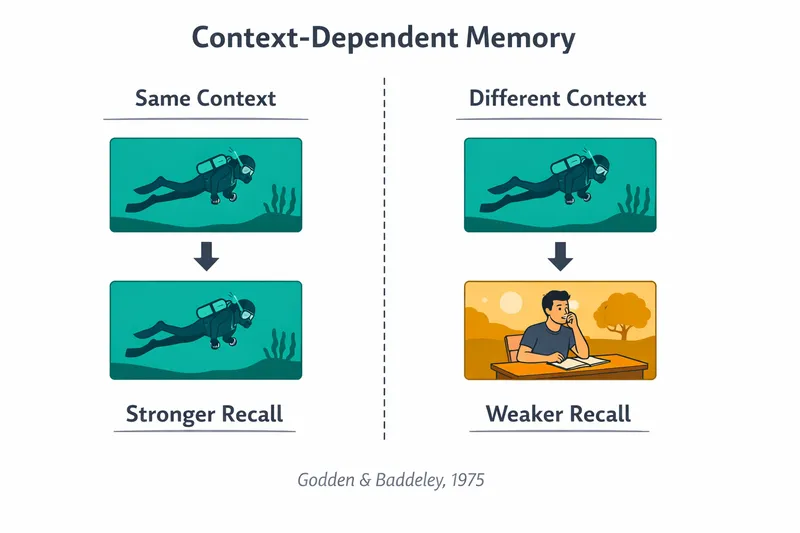
In 1975, a group of scuba divers did something that seems unremarkable until you think about it: they learned a list of words. Half of them learned the list on dry land. The other half learned it underwater. Then both groups were tested — some in the same environment where they’d learned, some in the opposite one.
The divers who were tested in the same environment where they’d learned recalled significantly more words. The ones who had to cross between environments — learn on land, test underwater, or vice versa — did worse. The physical context of learning had become part of the memory itself.
Godden and Baddeley published those results in 1975, and they’ve been cited ever since as one of the clearest demonstrations of what researchers call context-dependent memory: the phenomenon where what you learned, and where you can best access it, are linked. Your brain doesn’t just store information — it stores information tagged with the environment where the encoding happened.
Your Brain Is Always Taking Notes on Where You Are
The mechanism behind context-dependent memory is sometimes called the encoding specificity principle. When you experience something, your brain doesn’t just record the content of the experience — it records the context too. The sounds in the background. The physical sensations. The light. The smell. The emotional state you were in. All of that gets bound to the memory trace. Later, when you’re trying to retrieve that memory, being in the same context makes retrieval easier because more of the original cues are available.
A 2001 meta-analysis reviewing 75 studies on environmental context-dependent memory confirmed that the effect is real and statistically reliable across a wide range of conditions. The average effect size is modest in controlled laboratory settings, but the principle is consistent: memory performance is better when the context at retrieval matches the context at encoding. The effect is strongest for free recall tasks and weakest when strong non-contextual cues are available — which makes sense, because richer cues can compensate for a mismatched environment.
The practical consequence is straightforward: the more you do something in a particular place, the more your brain associates that place with that activity. The environment becomes a cue. Walk into a kitchen and you feel slightly hungry. Walk into a gym and your body starts preparing for exertion. Walk into your bedroom and your nervous system starts winding down — because that’s what you’ve always done there.
This is not metaphor. It’s conditioning.
The Bedroom Problem
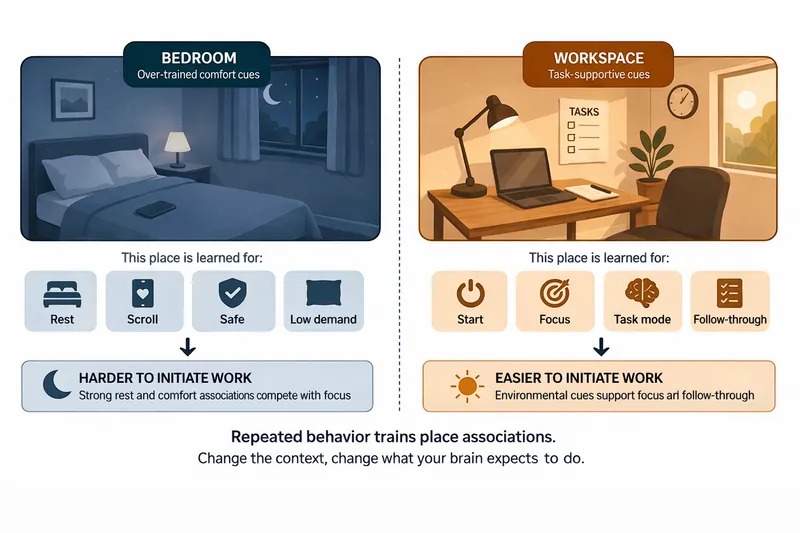
If you sleep in your bedroom — only sleep, consistently, for years — your brain learns that the bedroom is a rest environment. The sensory cues associated with that space become powerful predictors of what’s about to happen. Your nervous system relaxes. Your arousal level drops. Your brain shifts away from alert, task-oriented processing and toward the lower-engagement mode associated with sleep and rest.
Now open a laptop.
The bedroom cues rest. Your brain doesn’t easily switch modes just because you opened a laptop.
The problem isn’t willpower. The problem is that you’re trying to do focused, demanding cognitive work in an environment your brain has spent years associating with the opposite state. The contextual signal says “wind down.” The task says “focus.” Those two things are in conflict, and the contextual signal has years of practice behind it.
This is why sleep researchers have a clinical intervention built entirely on this principle. Stimulus control therapy for insomnia, first described by Bootzin in 1972, instructs patients to use the bedroom only for sleep — not reading, not television, not worrying, not lying awake. The goal is to rebuild the brain’s association between the bedroom and sleeping. Break the competing associations, and the environment becomes a cleaner cue for the behavior you actually want.
Stimulus control therapy is one of the core behavioral components of cognitive behavioral therapy for insomnia (CBT-I). A 2023 systematic review and meta-analysis found that stimulus control instructions produced meaningful improvements in sleep onset latency and total sleep time compared to passive control conditions. The underlying logic — that repeated association between a space and a behavior changes how the brain responds to that space — is exactly the same mechanism that makes working from a bedroom neurologically harder than it sounds.
The inverse is also true. If you want a space to support focused work, you need to build that association deliberately and protect it. Use the space only for work. Let the brain learn what happens there. Over time, walking into that space starts to prime the very cognitive states you need.
Why ADHD Makes This Harder
For most people, the bedroom-as-rest-environment effect is a mild inconvenience. For people with ADHD, it’s a significantly larger obstacle — and the reason comes down to how the prefrontal cortex functions differently in ADHD brains.
The prefrontal cortex (PFC) is the part of the brain responsible for what researchers call top-down attention — the ability to direct your focus toward something relevant to your goals even when it isn’t inherently interesting or stimulating. It handles task initiation, sustained attention, and the suppression of distracting information. It is also, consistently and reliably, the region most affected by ADHD.
Imaging studies show that people with ADHD demonstrate weaker activation in prefrontal circuits while trying to regulate attention and behavior. The PFC is also the last region of the brain to mature developmentally — and in ADHD, that maturation is delayed by several years. What this means functionally is that the ADHD brain is working with a prefrontal cortex that has less capacity to generate the attentional state you need on demand, particularly under low-stimulation conditions.
Research from Arnsten at Yale describes the PFC as the brain’s conductor for top-down attention — it directs cognitive resources toward what’s goal-relevant and suppresses distractions. In ADHD, PFC circuits show consistently weaker activation during tasks requiring attention regulation, and the region is highly sensitive to its neurochemical environment. Neuroimaging work by Shaw and colleagues at NIMH found that in children with ADHD, the prefrontal cortex reached peak cortical thickness about three years later than in typically developing children — the delay was most prominent in exactly the regions involved in attention control.
The consequence for environment is this: a neurotypical person might be able to override a mismatched environmental cue through top-down effort. The environment says “rest,” but they can push through it with willpower and get to work. For an ADHD brain, that top-down override is harder to generate and harder to sustain. The environmental signal carries more weight because the internal signal is weaker.
This means environmental design isn’t a productivity hack for ADHD brains. It’s closer to neurological scaffolding. The right environment does some of the work your prefrontal cortex is struggling to do on its own. The wrong environment creates an obstacle your prefrontal cortex may not have the capacity to overcome.
What You Can Actually Do With This
You probably can’t gut-renovate your living situation. Most people can’t. But you can work with this at a smaller scale.
The principle isn’t “you must have a dedicated office.” The principle is that your brain learns from repetition, and you can shape what it learns. If you always do focused work in one specific chair, with one specific setup, at one specific time, that context starts doing work for you. It becomes a cue for the cognitive state you need. The association builds over time, and eventually the environment starts priming your brain before you’ve even opened a single tab.
The corollary is also worth sitting with: if you do everything everywhere — work from bed, take calls from the couch, do deep focus wherever you happen to land — you dilute those associations and lose the environmental cue entirely. The context stops helping because it has no consistent signal to carry.
Your brain is always learning where it is and what happens there. The question is whether you’re being intentional about what you’re teaching it.
- Context-dependent memory is real and well-documented: your brain tags memories and behaviors with the environment where they were formed, and retrieval is easier when the context matches.
- The bedroom is not a neutral workspace. Years of sleep and rest have trained your brain to associate that environment with winding down. That conditioning doesn’t pause when you open a laptop.
- ADHD amplifies the problem. Weaker prefrontal function means less capacity to override a mismatched environmental signal through sheer effort. Environment matters more, not less, when top-down attention regulation is harder.
- You don’t need a dedicated office. You need a consistent context. One chair, one setup, used consistently for focused work, builds an association over time that starts to do cognitive work for you.
- Environmental design for ADHD isn’t about aesthetics or productivity tips. It’s neurological scaffolding; offloading some of the work your prefrontal cortex is struggling to supply on its own.
- Godden, D.R., & Baddeley, A.D. (1975). Context-dependent memory in two natural environments: On land and underwater. British Journal of Psychology, 66(3), 325–331.
- Smith, S.M., & Vela, E. (2001). Environmental context-dependent memory: A review and meta-analysis. Psychonomic Bulletin & Review, 8(2), 203–220.
- Arnsten, A.F.T. (2009). The emerging neurobiology of attention deficit hyperactivity disorder: The key role of the prefrontal association cortex. Journal of Pediatrics, 154(5), S22–S31.
- Shaw, P., Eckstrand, K., Sharp, W., Blumenthal, J., Lerch, J.P., Greenstein, D., Clasen, L., Evans, A., Giedd, J., & Rapoport, J.L. (2007). Attention-deficit/hyperactivity disorder is characterized by a delay in cortical maturation. Proceedings of the National Academy of Sciences, 104(49), 19649–19654.
- Jansson-Fröjmark, M., Nordenstam, L., Alfonsson, S., Bohman, B., Rozental, A., & Norell-Clarke, A. (2023). Stimulus control for insomnia: A systematic review and meta-analysis. Journal of Sleep Research, 33(3), e14002.